

This website uses cookies so that we can provide you with the best user experience possible. Cookie information is stored in your browser and performs functions such as recognising you when you return to our website and helping our team to understand which sections of the website you find most interesting and useful.

The Theatre
The Orchestra
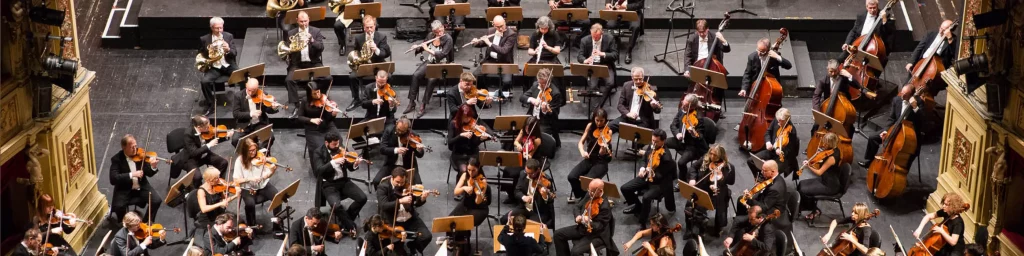
The Orchestra of Teatro Lirico Giuseppe Verdi di Trieste has been a permanent ensemble since 1944, when it took on the name of “Filarmonica Triestina”; in 1964 it was named after the theatre it perfoms in.
It is worldwide known for its ability in performing a wide opera and symphonic repertory and has been conducted over the years by internationally renowned maestros, including Herbert von Karajan, Claudio Abbado, Riccardo Muti, Paul van Kempen, Thomas Schippers, Mario Rossi, Carlo Maria Giulini, Laslo Somogryi, Leonard Bernstein, Sergiu Celibidache, Gianandrea Gavazzeni, Daniel Oren, Gary Bertini, Gustav Kuhn, Jean Claude Casadesus, Sir Neville Marriner, Nello Santi, Gianluigi Gelmetti, Donato Renzetti and many more.
It has often been invited to perform abroad, holding series of symphonic concerts in France, Germany, Austria, Hungary, Slovenia and Croatia. The Orchestra was a notable feature at the Festival of the Two Worlds of Spoleto from 1958 to 1969. The Verdi Orchestra commitment to spreading the culture of music in the Friuli Venezia Giulia Region (Pordenone, Udine, Gorizia) – as well as in neighbouring Istria – goes back several years.
In 2014 the Orchestra took part to a tour in Oman, where it opened the new season at the Royal Opera House Muscat (ROHM) with a stunning and successful production of Verdi’s Macbeth “resulting in an unforgettable opera that left one shivering long after the curtain came down” (Times of Oman review).
In 2016 it has opened the Dubai Opera with a concert performed by the tenor Placido Domingo and with the operas The pearl fishers and The barber of Seville, two production set by the Foundation itself.
The Verdi Theatre Orchestra is featured in record catalogues with the complete symphonies by Mendelssohn, Schumann and, in addition, with the Stabat Mater by Dvorjak, conducted respectively by Lü Jia and Julian Kovatchev. Besides the historic recordings of its concerts at the Festival of the Two Worlds during the Fifties and Sixties, the Verdi repertoire includes live recordings of several operas, namely Il Campiello by Wolf Ferrari; La Straniera by Bellini (for the Fonit-Cetra/Ricordi label); Attila and Stiffelio by Verdi (for the Dynamic label); Ginevra di Scozia by Simon Mayr (for Opera Rara); a DVD of Tancredi by Rossini; as well as a DVD and CD of the opera I Cavalieri di Ekebù by Riccardo Zandonai, a CD of Lohengrin by Richard Wagner, both produced in 2005; the last release is a DVD of Battaglia di Legnano by Giuseppe Verdi recorded for the collection Tutto Verdi – The complete Operas (for the Unitel Classica label), which includes all the productions of the great composer performed by the most prestigious European Opera houses.
Orchestra members
First Violin
Stefano Furini*
Roberta Nitta
Andrea Schibuola
Eliseo Baldizzi
Giuseppe Carbone
Romina Concion
Rossella Ivicevic
Franca Sciarretta
Stefano Toso
Second Violin
Valentino Dentesani*
Giuseppe Dimaso
Paolo Blazina
Federico Crisanaz
Diana Mustea **
Andrea Nanni
Sara Rizzuto
Stefano Sommati
Viola
Benjamin Bernstein*
David Briatore*
Elisabetta Chiappo
Giorgio Gerin
Mario Leotta
Laura Menegozzo
Claudio Pizzamei
Davide Prelaz
Cello
Matteo Salizzoni*
Tullio Zorzet*
Andrea Di Corato
Adriano Melucci
Simona Slokar
Chiara Urli
Double bass
Chiara Molent*
Livio Pavese
Danilo Sisto
Michele Veronese
Flute
Giorgio di Giorgi*
Valter Zampiron*
Maria Ginaldi
Piccolo
Daniele Porcile
Obo
Paola Fundarò*
Francesca Guerra*
Marco Bardi
English horn
Giovanni Scocchi
Clarinet
Marco Masini*
Stefano Torcellan*
Bassoon
Matteo Rivi*
Claudio Verh*
Horn
Simone Berteni
Chiara Bosco
Giorgio Raseni
Trumpet
Živa Komar*
Massimiliano Morosini* **
Carlo Beltrami **
Massimiliano Oldrati
Trombone
Domenico Lazzaroni*
Luca Erra
Alberto Ventura
Timpani
Paolo di Nisio*
Fabian Perez Tedesco* **
Percussion
Antonio Marotta
List in alphabetical order
*first part
** with a fixed-term employment relationship
Updated 1 September 2023
See also
Torna su